- The Existential Inbox
- Posts
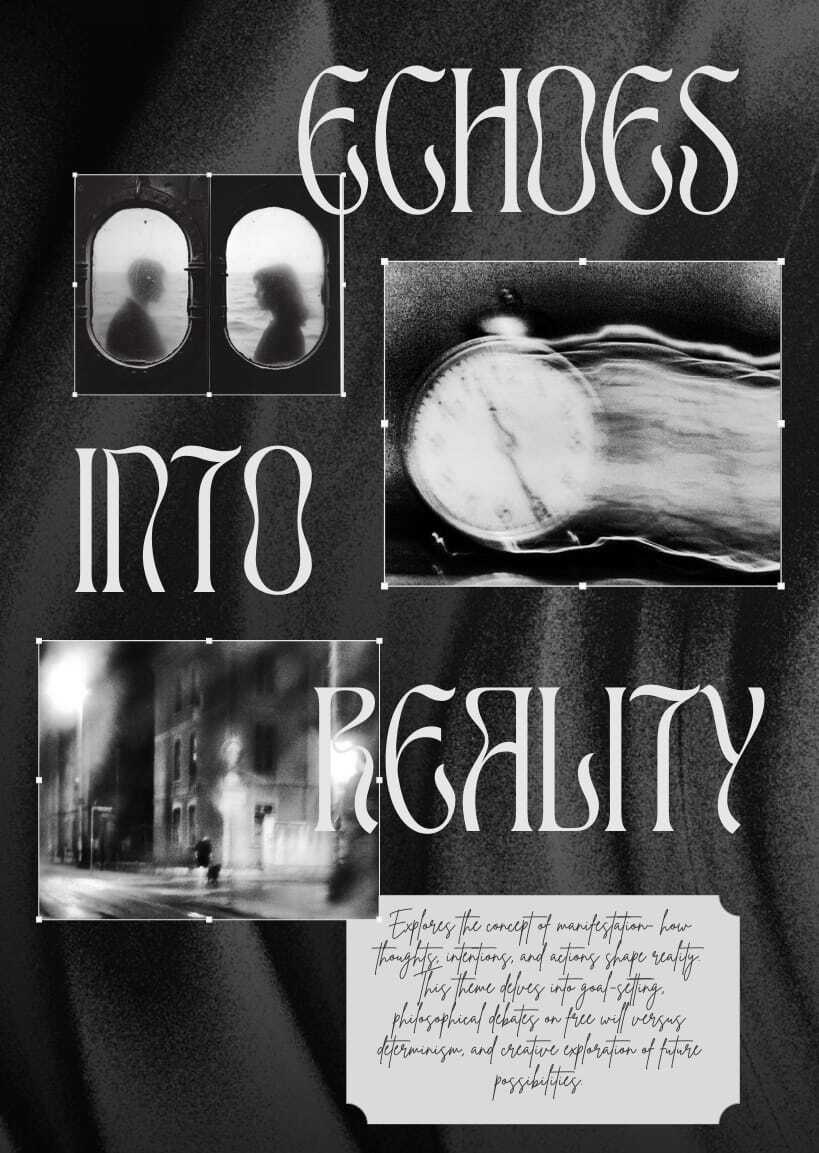
- Echoes into Reality, redux
Echoes into Reality, redux
"...can cause a hurricane in Texas."

Philosophy and open discussion
March 16, 2025

Welcome back. beloved readers.
Glad to have you back with us.
Do you remember the journey we went on? We sailed through the void, frolicking through fields of candy and the magic of 11:11, read of stories featuring dreams coming alive for our friends, and heard out the “victims” of our dear journalist’s hearty interrogations.
This week, we have something equally fascinating in store: from science to synchronity to sorcery, are you prepared to dive into the trenches of manifestation?
The butterfly seeks to change the world, but how exactly will it do it? How will its dreams and desires bloom into the abyss? How will its reverbations change the world?
Or will it be changed, in turn? Will it be crushed by the weight of the vacuum, its passions corrupted as they turn inside out, revealing its innards for the whole world to see?
But none of those questions are important, really.
The most pressing question, now:
Do you still dare to paint the universe?

Source: Design Team, Philosophy and Open Discussion Club
“I Did It All My Way” or “Que sera, sera”? By Catherine Oviya
Picture this (completely hypothetical, mind you!) scenario.
It’s 6.30 AM, and your alarm rings. Some distant part of your brain reminds you that you absolutely must wake up to catch the bus - if you miss this one, you’ll have to make the perilous traversal to the main road to catch the other one. In your haze of sleep, you hit the snooze button and fall back into the throes of dreamland.
To the surprise of absolutely no one, you miss your bus.

Source: Neon Genesis Evangelion (1995) Episode 26: The Beast that Shouted ‘I’ at the Heart of the World
Now, as you’re furiously speedwalking the two blocks, you curse yourself for your choices, and look back at the long string of events that led you here. Did you truly “choose” to hit the snooze button and sleep in more, or was it “predetermined” by the fact that you stayed up until 3 am last night playing Dress to Impress with your friends and blaming your lack of stylistically coherent outfits on the finicky Roblox controls?
(Ahem. This is all a total hypothetical, of course. The author totally has an amazing sense of fashion. Totally.)
As you finally board the bus and groan internally as you realise there are no seats, you too can participate in the philosophical debate that is as old as humanity:
Do our decisions blaze through the cosmos like a comet, or is our fate written into the stars from time immemorial?
Life, The Universe, And Everything In It
This dispute is a time-honoured debate - it stretches back to the very beginning of philosophy itself. Every philosopher worth his salt had a say - resulting in a far-reaching cascade of ideologies. Let’s travel back through time and touch upon some key ideas relevant to the conversation.
300 BCE – The Stoics:
The Stoics were a group of philosophers who developed a school of thought known as Stoicism in ancient Greece around the 3rd century BCE, centered around their ideas of determinism. At its core, Stoicism teaches that while we cannot control external events, we can control how we respond to them; emphasizing the power of inner peace and resilience. Everything happens for a reason, they argued, but freedom comes from mastering your response to life’s events. Think of it like navigating a river—you can’t control the current, but you can steer your boat.
4th Century CE – St. Augustine:

Source: St. Augustin by Philippe de Champaign (oil on canvas)
St. Augustine was a Christian theologian and philosopher whose writings and ideas had a profound impact on the development of Western Christianity and philosophy. How is one to grapple with the idea of free will whilst believing in an omniscient, omnipotent supernatural God?
He proposed that God was much like an observer: God knew the decisions that would be made by humanity, but He would not interfere - He would let us choose our own destinies freely. He knew that Eve would eat from the Tree of Knowledge of Good and Evil, but He let it happen because it was a choice made willingly by humanity.
17th Century – René Descartes:

Source: Design Team, Philosophy and Open Discussion Club
Rene Descartes is a famous mathematician and philosopher, often called the “Father of Modern Philosophy”. (Fun fact: he is the very guy responsible for Cartesian geometry, so blame all your frustrations with parabolas and hyperbolas on him. I certainly do.)
His famous saying: cogito, ergo sum (“I Think, Therefore I Am”) is a testament to humanity’s inherent capacity for free will - if we can think freely, we can live freely: and therefore, we exist.
18th Century – Pierre-Simon Laplace:

Source: Design Team, Philosophy and Open Discussion Club
Now, we’re getting into the fun stuff. Pierre-Simon Laplace proposed a rather interesting thought experiment: he envisioned a mythical creature of infinitely superior intellect that could comprehend both the positions and the motions of every single particle in the universe would definitely be able to predict the future. (Sound familiar, fellow Heisenberg’s Uncertainty Principle enthusiasts? No? Just me?)
This being was termed Laplace’s Superman, or more famously, Laplace’s Demon. To this Demon, nothing in the universe would be a surprise. It knew and comprehended every single event that had ever occurred - and therefore, it would be able to predict the future to pinpoint accuracy. He argued that Free Will was just an illusion - total knowledge of the past would mean total knowledge of the future.
18th Century – David Hume:
David Hume took a look at all of the above arguments, and said - well, why not both? Both is good!

(David Hume essentially decided to get bisexual with this whole argument. More proof that biseuxals are just inherently the solution to every philosophical problem ever. Source: Bisexuality pride flag by Michael Page. )
His writings offered a middle ground: determinism and free will can co-exist. As long as our actions and choices in the present moment are in alignment with our own internal desires and consistent with our ideologies and logic, we are truly free. Liberty and necessity need not be in conflict, he says. In fact, the two are tightly interlinked by causation and individual choices.
19th Century – Friedrich Nietzsche:

(As always, Nietzche continues to stay based. Source: Photograph of Fredrich Nietzche with the Deal With It meme glasses.)
Ah, Nietzche! Everyone’s favourite Nihilist philosopher! I simply had to give him a section in this timeline. Or well, did I? We are talking about free will, after all :)
Nietzche’s view of free will was a tad different. He described the existence of a fundamental human drive: the will to power, the inherent core sewn into the fabric of every being. It is a force within every human being to exert themselves into the world, to push forth and continue to exist, to attain a sort of equilibrium with the environment around them. True freedom comes from rising above constraints to make authentic choices that are not limited by the environment that you are a product of.
20th Century – Quantum Mechanics:
Source: Design Team, Philosophy and Open Discussion Club
As you can tell from our previous discussions, the question of Determinism and Free Will is inherently tied up with the ideas of science - Newtonian Mechanics were inherently deterministic as they declared that the world could eventually be fully categorized into a set of laws. And so, all of science set about trying to do so, and they got really, really close. In fact, Lord Kelvin once said: “There is nothing more to be discovered in physics now. All that remains is more and more precise measurements.”
And then came Quantum Mechanics.
At the subatomic level, particles behave in strange and unpredictable ways. Particles exist in a state of superposition unless observed, meaning that their machinations are truly, fully random and chaotic. This theory entirely disproves the concept of scientific determinism, allowing ideas of free will to develop and thrive.
Now, let’s bring it all back to where we started: that fateful day, where you were late for the bus.
As you stand there, hand gripping the pole for dear life, your mind begins to get increasingly restless. Without your headphones (just your luck, of course you forgot them in your frantic rush), you begin to question the very fabric of reality.
Why did you end up here? Why did you choose this college? Did you truly have no other choice? Could you have studied a little harder, fought a little more, stayed up a few more nights to review a few extra past papers? Or was that simply your destiny - or as they say quite eloquently in Tamil, your thalavidhi (literally head-fate)? The Stoics might say: yes, this was determined, but you could have made better choices to steer your future.
Why did you stay up all night? Why didn’t your Mom tell you to go to bed when she saw you up at 10.00? Maybe she was simply a follower of the St. Augustine’s idea of free-will: she left you to your own devices, quite literally.
Why did you not play something different? Maybe Among Us would have been nice. Of course, then you would have to somehow find a way to NOT be instantly ejected, like always. It would have been up to your wits and your 220 IQ plays to establish your presence and seize victory.
Why do you suck at Roblox? Maybe it’s time to try a different game, buddy. You don’t know all about how it works, and probably never will. But it’s nice to dream of a hypothetical future where you’re an absolute beast at Roblox Obbys, isn’t it?
Where are you going to have lunch? C’mon. Don’t look at me like that. Very valid question. You’re hungry, you didn’t have breakfast properly. The canteen and the mess are both going to be open, and you’re free to take your pick. Oh, but you don’t really like the Wednesday mess food, and there’s probably pizza which you’re really beginning to crave right now…canteen it is, then.
There’s an event going on today. Should I go? Oh, your favourite club of all time (coughcough Philosophy and Open Discussion Club coughcoughcough) is organizing an event today - it’s really fascinating and cool and awesome, something about the philosophies of manifestation? Oh, but you didn’t get your OD letter signed, and your teacher will probably give you the stink eye if you skip Lab, and you might get an earful from your HOD if your attendance percentage goes too low, but hey. You really wanna go to the event and show everyone what you’re made of!
And finally: your friends. You think back to what happened yesterday (well, today) night; of all the highs and lows, all the frustrated yelling as you utterly failed to figure out how to appropriately layer your outfit, all the times your friends were breathless with laughter as they saw each new fit that you managed to somehow scrape together; and you just wonder. What universal machinations led them to your orbit? Was it simply determined - were you all fated to exist in the same space since the atoms of your bones were being knit together in the core of a supernovae? Or was it just random chance; the loom of chaos weaving together all of your lifelines and knotting them together with a messy bow?
And finally:
Does it really matter, in the end?
And so, after an hour of philosophical introspection, you get off your bus, mumbling apologies and fumbling with your bag. You step out into the sun.
As always, it is a beautiful day. Whether or not you chose to be here, or you were always destined to be here - the fact is, you are here. Make the most of it.

(You fools, this was a secret subliminal advertisement for Neon Genesis Evangelion after all! Muahahahaha!
Source: Rebuild of Evangelion: 3.0+1.0 Thrice Upon a Time
The Journey to Synchronity
By Sriram
My mom always says “Think good, and good will happen to you”, but I don’t buy into that idea completely. Have you ever thought of this philosophical question: “Do you do what you think OR Do you think what you do”. Now, read that again. Well, most of the time we don’t do what we think. We think a lot of things, but very few of your thoughts get transcend into Action. Not all of our self-reflection gets into the action stage, but all of your action that you have done gets into the reflection stage. So, its not thinking that leads to action, but action that leads to thinking. That’s exactly the problem with manifestation - it focuses on thinking->action, not action->thinking.
Moreover, many manifestation rituals completely forget the action part. All they say is, “you haven’t manifested it enough”. And fools keep doing it more, to find out that it is complete BS. But, that again, is the problem. You go to the either extreme. The truth lies somewhere in between. Why, you ask? I’ll tell you. You know when is a good lie to scam people is crafted, it is crafted when it has some amount of truth in it to make the people believe. That’s how this manifestation concept was created and popularised by the “Secret” book.
So, after having gone through both extremes, let me separate the chaff from the wheat and feed your psyche with the truth that I found during my Philosophical Search backed up by some of Jung’s psychological concepts.

Source: Design Team, Philosophy and Open Discussion Club
There is this great psychologist named Carl Jung. He provided us with a concept somewhat related to manifestation but more spiritual. It’s called “Synchronicity”. Fancy word, right? Definition: The simultaneous occurrence of events which appear significantly related but have no discernible causal connection. Let me explain it to you.
Have you ever experienced something like this: You randomly think, dream or remember of an old friend of yours, whom you haven’t spoken to in a long time, and then, they coincidentally text you or you accidentally meet? Events like this – we’ve all experienced them at some point in our lives. That’s the concept. He says such coincidences are more than just probability; they are meaningful connections. They occur when an inwardly perceived event (dream, vision, premonition, thought or mood) is seen to have a correspondence in external reality. The inner world and the outer world coincide bringing meaning to your path.
Jung says it does not happen all the time, because it’s not just about you manifesting enough to make it a reality. On the road to your goal, you try a lot of things, fail, learn, try again, and then suddenly, at one point, the world starts aligning with you, because you have made yourself worthy of the thing to happen and now the world starts giving you many meaningful coincidences to get you closer to success. It is famously stated in the words: “What you seek is seeking you”.

Source: Design Team, Philosophy and Open Discussion Club
The Weird Side of Manifestation
By Akshitha

Source: Design Team, Philosophy and Open Discussion Club
After learning about all the general and bright sides of manifestation, one might consider being simply optimistic and having good intentions to achieve one's personal goals and interests, which doesn't sound so bad. But every coin has two sides, and this is where things get ugly.
People can be many things - kind, rude, happy, angry, sad, lonely, but desperation brings out the worst in them and they push any person to their lowest making them do insane things in every sense.
People are changing themselves bit by bit by doing absurd things and are losing their sanity to achieve something, like changing the direction they breathe in or going to places across the globe just to backflip their way off a cliff thinking their manifestations will come true if they survive or even using their hair and blood to write their wishes down. It makes us wonder if people have lost their capability to comprehend reality from delusions...?
People will do anything to have what they want and manifesting probably seems like the shortest and easiest way to get it done or so you may think in the initial stages but things could go wrong at any point in life. You could end up with broken bones, inducing traumas in yourself, or even start a cult given that you're already part of this one.
As the saying goes, "Too much of anything is good for nothing". Just like too much sugar in your tea isn't good, so are too many beliefs in manifestations or rather too many manifestations in your life. It wouldn't be so bad if everyone manifested with a limit and didn't get gaslighted into doing absurd things by those people preaching about them online as their ways of successful manifesting. If you have experiences with those I'm sorry for you, get some help.
Scrolling, the Instagram - FYP has never felt as disgusting as it was after looking up #manifestations. Every single post, reel, and even thread was chapri to the core. There is stuff that slaps all the bad karma out of you virtually when in reality you were just gonna start experiencing it now.

Source: Design Team, Philosophy and Open Discussion Club
A simple search of #manifestation on social media could get your mind boggled. Cause stuff sometimes ends up getting gory as hell. But just because people are desperate doesn't mean they'll lose all logic and reasoning... Right??
Umm.. well you all deserve to know at least the bare minimum absurd things humans are capable of recommending as ways of manifesting. Starting with Bay Leaves, pretty normal leaves we use in enhancing flavors in dishes but nope we shall now write our wishes on them with a red marker and later burn it all away sharply at 11:11 that too facing northeast. Seriously?? WTF is that supposed to do a genie sounded way more convincing. But we listen and we don't judge even if it is said by a fat Bengali aunty with a huge ass bindi just so that she doesn’t end up in our dreams.
Other manifestation gurus are now teaching us how to enter and leave the quantum realm where all the things we want supposedly exist. Even Ant-Man couldn't crack that one. They also claim screaming and chanting loudly would be enough to connect you to alternate dimensions. In reality, all you could be left with is ear pain, sore throat, and a tons of lawsuits regarding public nuisance filed against you.
Since experiments like those on bay leaves were not enough they chose Water to be the ultimate and most basic manifestation medium. Apparently whispering affirmations to the glass of water that you are holding in your hand and drinking it as soon as you charge it under moonlight makes your affirmations come true, sorry to let you know it's still just H2O nothing more, nothing less.
They then brought this magic water to the next level by inventing love potions. Why not? with the number of single members in this generation's youth who would do anything for a relationship? There are recipes available online with various ingredients some of which you may find on either your mom's shelves or at Hogwarts.
But in all seriousness, manifestation took a dark turn when people started making voodoo dolls to make their crush fall for them. Why bother with conversation or compatibility when a few stitches and a lock of hair can handle the heavy lifting?? Nothing says romance like borderline witchcraft.

Source: Design Team, Philosophy and Open Discussion Club
At last, you all know you have to stop scrolling in the FYP when the usual AI Siri-like voices that used to spout weird shit about manifesting practices turn into SRK's voice gaslighting you by giving hope from a random dialogue out of a Bollywood movie about achieving happiness to sucker punch that last bit of reasonability out of you by getting your desi side all worked up.
This insane movement of manifesting reflects a deeper cultural obsession with quick fixes and shortcuts. It’s easier to burn a bay leaf than to work hard, and chanting affirmations feels less daunting than actual self-improvement. Yet beneath the pastel filters and mellow AI voices lies a truth: hard work, persistence, and genuine connections will always outshine rituals involving water.
Manifestation culture isn't all bad – it reminds us of the power of optimism and intention. But when that optimism crosses into delusion, we risk losing the essence of what makes personal growth meaningful. Maybe the universe does listen, but it’s likely waiting for us to meet it halfway with effort and authenticity. Until then, keep your bay leaves for cooking and your water for drinking – some things don’t need extra magic.
–
And so, our foray into the world of echoes draws to a close. The echoes - whispers carrying the thoughts, dreams and intentions of a sleeping chrysalis waiting to blossom - reverbate into infinity, carrying with it fragments of its essence.
How can we love a world, spinning endlessly through its revolutions? Each turn of the wheel an ancient echo. What was is what will be. Joy and sorrow, birth and death, creation and decay. The world creaks and groans under the weight of ‘forever’.
There is nothing new under the sun. Every word uttered has been uttered before, in different permutations and combinations, stretching on into infinity. There is always something better, something more valuable, more ideal, more unique. Forever tantalizing, forever unattainable, always just out of reach.
A being (the eternal, epheremal “you”) screams: “What is the truth?”
Silence.
That is all the answer you need.
There is no “truth”. You are a fleeting whisper in an indifferent cosmos, a grain of sand swallowed by the waves. The universe deigns you too insignificant to answer. To it, you are neither triumph nor tragedy, but a fleeting flicker so imperceptible that even the act of overlooking you would demand more attention than you are worth.
And yet, humble little butterfly persists. Its wings, gossamer thin, beat steadily on, embroidered with the fragile, web-like threads of hope. Its destination remains unknown as it dances on to the cosmic background radiation of the Alpha and the Omega. Call it what you will - resilience or foolhardiness. Idealism or nihilism. Hope or human nature. Does it matter what we call it? It still sails on.
You whisper: “Who exactly is it, right now, pictured in your heart?”
The butterfly answers: “I am all of the things in existence.”
Reply